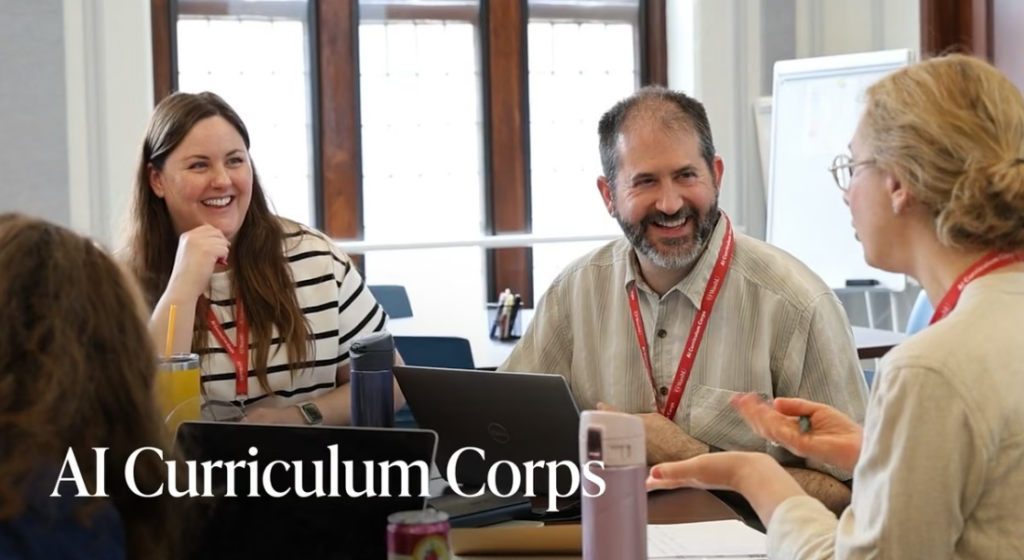
This summer, the AI Curriculum Corps brought together faculty, instructional designers, librarians, technologists and student partners from across WashU’s schools to thoughtfully integrate artificial intelligence into teaching and learning, with much of the work centered on undergraduate instruction on the Danforth campus.
As faculty design new AI-enhanced assignments and courses, WashU IT provides the technical expertise that helps turn innovative ideas into practical learning experiences. Matt House, Solution Architect Lead in WashU IT, works closely with faculty participating in the AI Curriculum Corps. He describes his role as helping “meet faculty where they are” in their use of AI, while making them aware of the tools WashU IT offers and helping them “use them safely and effectively.”
The AI Curriculum Corps is part of the university’s AI initiative, preparing students for a future where AI is becoming part of nearly every profession. More than 80 faculty proposals were selected for the inaugural cohort, which brings together 82 faculty from eight WashU schools representing various disciplines across the university—from engineering and business to law, medicine, public health, and the humanities.
Through the AI Curriculum Corps, faculty are exploring how AI can strengthen critical thinking, improve feedback, support research and encourage students to examine both the opportunities and limitations of the technology. House believes higher education is “experiencing a paradigm shift, where AI is a collaborator in student success, both for the faculty member and for the students themselves.”
For House, the conversation goes beyond the technology itself.
“It’s not about how the technology works. It’s about how to use it effectively as part of the teaching and learning mission of the institution.”
Throughout the weeklong workshops, faculty collaborated with colleagues from the Center for Teaching and Learning, the DI2 Accelerator, WashU Libraries, the Office of the Provost and WashU IT. Together, participants redesigned assignments, explored AI platforms, discussed privacy and security considerations, and evaluated how AI could support their course learning objectives.
House describes the partnership as “a highly effective, highly successful collaboration,” explaining that “we each have our areas of expertise that we bring in and make the overall product better as a whole.” The Center for Teaching and Learning contributes pedagogical expertise, ensuring the focus remains on learner-centered teaching with AI. The Office of the Provost, through Institutional Effectiveness, provides the program’s direction and helps measure its outcomes. DI2 brings “the coordination and inspiration aspects” of the initiative, helping “take the vision into reality” while managing the logistics and support that make the program possible. WashU Libraries provides guidance on accessing and appropriately using academic resources within AI platforms, while WashU IT delivers enterprise-scale AI tools and helps faculty build the confidence and skills to use them effectively.
That partnership is already shaping innovative classroom experiences. One faculty member teaching conversational Italian had an idea for helping students engage in authentic conversations but was still refining how to bring it to life. Through one-on-one collaboration and experimentation with AI tools, House said the instructor “had a fully fluent Italian bot that had a pre-programmed personality,” creating a conversational partner that gives students an immersive way to practice the language.
For House, projects like these demonstrate one of WashU IT’s greatest contributions: helping faculty move from an initial idea to an effective teaching strategy by pairing instructional goals with the right AI capabilities.
Faculty participating in the AI Curriculum Corps represent disciplines as varied as conversational Italian, software engineering, political science, medicine, business, and the humanities, yet many are wrestling with the same questions: How can AI help students learn more deeply? How do we encourage critical thinking instead of overreliance on technology? How do we prepare graduates for a rapidly changing workplace?
One of the biggest surprises for House has been “seeing the various disciplines actually working together to provide each other perspective,” creating opportunities for faculty to learn from colleagues whose approaches to teaching may be very different from their own.
House believes AI should strengthen—not replace—the learning process.
“Critical thinking is still the key. You have to think about what you’re providing to the AI to give it an appropriate context and consider what is coming out.”
He points to classroom discussions as one example. If students rely on AI to read assigned materials for them, “that doesn’t work,” he said. “You still want to have critical conversations with your peers in addition to just processing information with AI.”
As faculty pilot their new assignments this fall and continue refining courses throughout the academic year, the AI Curriculum Corps will continue supporting instructors through collaboration across academic and technical teams as AI technologies continue to evolve.
Looking ahead, House hopes faculty leave the program feeling “empowered to effectively integrate AI into their coursework.”
As AI continues to evolve, the AI Curriculum Corps will continue supporting faculty through collaboration across the university. WashU IT will continue providing the tools, guidance, and technical expertise that help instructors use AI effectively and safely as part of their teaching.