A message from Jen Stedelin, Interim Vice Chancellor for Technology and Chief Information Officer
I hear a version of the same question from across our teams pretty often: what is our IT Operating Model, and why does it matter to the work I do every day? It’s a fair question — some of our four priorities are easy to feel in your daily work, and others are quieter, foundational work that pay off over time. So today I want to give you a real update, with real progress, on all four.
Two years ago, we set out to build a more consistent, more connected way of operating across WashU IT. Not because consistency is a nice idea in the abstract, but because it’s what lets us show up better — for each other, and for the students, faculty, staff, clinicians, and researchers who depend on us. I’m proud of how much of that work is now real. While the Senior Leadership and our Senior Staff teams have identified roughly a dozen top priorities as part of our operating model, we intentionally broke this model into chunks – focusing on four main initiatives first, with plans to introduce additional priorities as we wrap up the current ones.
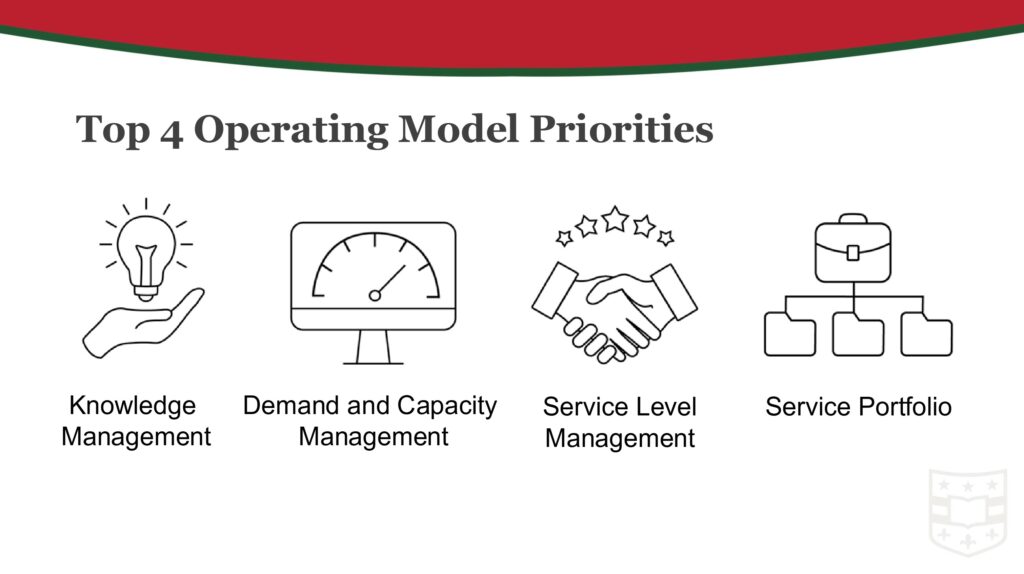
As a reminder, the four current priorities are Knowledge Management, Demand and Capacity Management, Service Level Management, and Service Portfolio.
Knowledge Management is about making sure staff and customers can find reliable, consistent information when and where they need it — no more guessing which tribal knowledge is still accurate. Phase 1 went live on August 24th, and nearly 100 staff members came to training to learn our new standardized process for creating, reviewing, and maintaining knowledge across IT. The full recording and learning resources are waiting for you on the Knowledge Management Teams space. I encourage you to explore them. The next phase will bring additional capabilities, including product pages and other improvements to the overall knowledge experience.
Demand & Capacity Management is the one most of you have felt most directly, because it’s the reason we moved from Planview Pro to ServiceNow SPM for strategic portfolio management and effort tracking. That migration, which involved moving hundreds of projects, tens of thousands of timesheets, years of portfolio data to a modern platform, is now live, and I want to acknowledge how much was required to complete this shift. It was never just a technology swap. It took months of planning, testing, training, and problem-solving, and it showed WashU IT at its best: governance, project management, resource management, ServiceNow development, change management, training, and operations all pulling in the same direction. Thank you to everyone who made that happen. If you still have training to complete in Workday Learning, please make sure it’s done. This platform is the foundation for how we’ll manage work, resources, and strategic investments across WashU IT for years to come.
For our two current priorities, we’re nearing completion of the Service Portfolio project — the piece of our Operating Model that gives us a clear, consistent framework for defining, governing, and communicating IT services across the organization. It’s foundational, which means you may not see it directly yet, but you’ll feel what it enables.
Future phases will focus on service offerings and service level management, bringing more clarity to what you can expect from our services and more consistency in how we deliver them.
Taken together, this is what unifying our operations actually looks like: not one big change, but a series of connected ones that make us easier to work with, inside and out. And we’re not done. As we move into the second wave of this work, you’ll hear about new priorities aimed squarely at streamlining our processes and improving efficiency — changes that should make your day-to-day work more productive, not more complicated. That same work is also what’s guiding how we show up for our customers. Our goal is a consistent, excellent experience for the people we serve, no matter which part of WashU IT they’re working with.
Thank you for the part you’ve each played in getting us here. I’m excited to share more with you soon.