
Pictured, Ryan Burge, PhD, professor of practice, Washington University in St. Louis.
Raw data remains one of the most underused assets in modern society – millions of rows of insight on economics, public health, social science and religious life, sitting buried in dense academic repositories and uninviting spreadsheets.
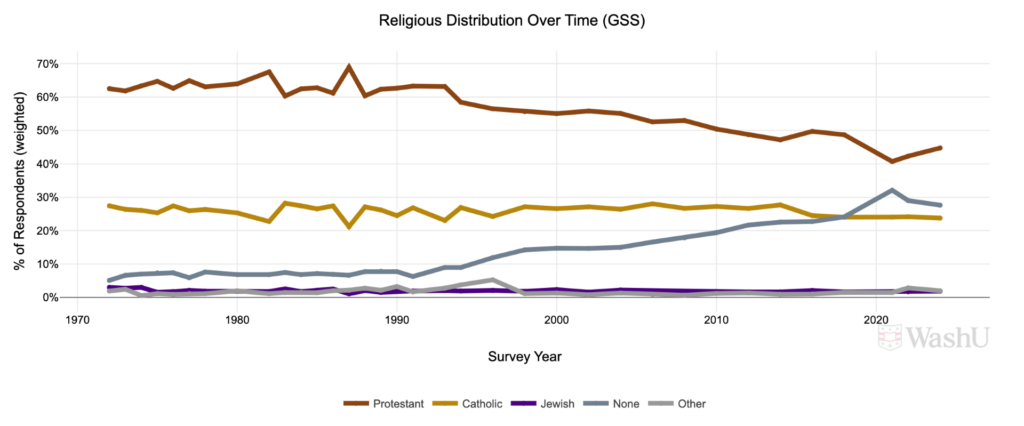
Closing that gap takes more than a good idea. It takes high-performance compute, expert infrastructure support, and a team willing to hand researchers the keys instead of a locked-down service. That’s exactly the role WashU IT’s Research Infrastructure Services (RIS) played in a project now drawing big attention: an agentic AI dashboard built by Professor Ryan Burge and a team of WashU students that turns decades of raw survey data into instant, plain-language insight.
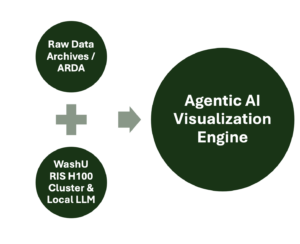
RIS is WashU IT’s high-performance computing and research-infrastructure team, the group that gives faculty and student researchers direct access to enterprise-grade GPU clusters, open-source foundation models, and the hands-on technical support to deploy them. For Burge’s team, RIS wasn’t a backend detail. It was the reason a five-to-six-week prototype was possible at all.
The problem RIS was built to solve
Ryan Burge, PhD, a professor of practice at Washington University in St. Louis and a nationally recognized researcher on religion and politics, has spent a decade proving the public’s appetite for objective, empirical data: six books, 30 peer-reviewed articles, and regular engagement with newsrooms, religious leaders and institutions from Congress to ivy-league divinity schools.
“People don’t lack interest in complex empirical data. They lack the technical bridge required to query and visualize it intuitively,” Burge said. “The goal is to build an agentic bridge between raw, multi-decade data archives and real-time visualization, turning static repositories into dynamic, conversational analytics platforms.”
Turning archives such as the Association of Religion Data Archives (ARDA) into something a journalist or curious reader can actually use takes serious technical lift. Burge partnered with student developers Namit Misra and Phil Zhang, working through WashU’s Digital Intelligence & Innovation Accelerator (DI2) Digital Transformation Research Corps; a paid, 10-week program pairing students with faculty on digitally enabled research. The result: a dashboard that lets anyone, from a high schooler researching Islam in America to a journalist fact-checking global Christianity statistics, query raw data in plain language and get a publication-ready chart back instantly.
What RIS made possible, specifically
- Enterprise hardware, direct access. The team deployed on NVIDIA H100 GPUs, the same tier of hardware labs like OpenAI and Anthropic use to train frontier models.
- Real cost savings. Hosting open-source models locally instead of iterating against paid APIs saved thousands of dollars during early testing.
- Full architectural control. “Using a commercial API puts you on their server with a set menu,” says Zhang. “RIS lets us be the chef — it gives us the raw ingredients and lets us add our own seasoning to configure open-source models around our own dataset.”
- Faster time to working software. With RIS documentation, lecture series and office hours, a typical two-week setup was running in days.
- Rare, transferable skills. Configuring and fine-tuning models on private GPU clusters gave student developers hands-on experience that’s scarce even in industry.
“Data itself is only as valuable as our ability to make it accessible, actionable and secure,” says Amy Walter, deputy CIO and associate vice chancellor, Clinical, Research and Medical Education Technologies. “By equipping researchers and students with infrastructure like RIS, WashU IT helps turn complex data into public insight, extending WashU’s reach well beyond campus.”
The project is currently a working minimum viable product (MVP) built on two datasets, with a long-term vision to scale into the thousands, becoming a go-to data engine for newsrooms, scholars and public leaders alike.
Great ideas need more than inspiration. They need powerful computers to bring them to life. RIS provides that foundation, so researchers can focus on the idea instead of worrying about the equipment.
Those curious about how RIS could support their research are encouraged to visit RIS.wustl.edu.