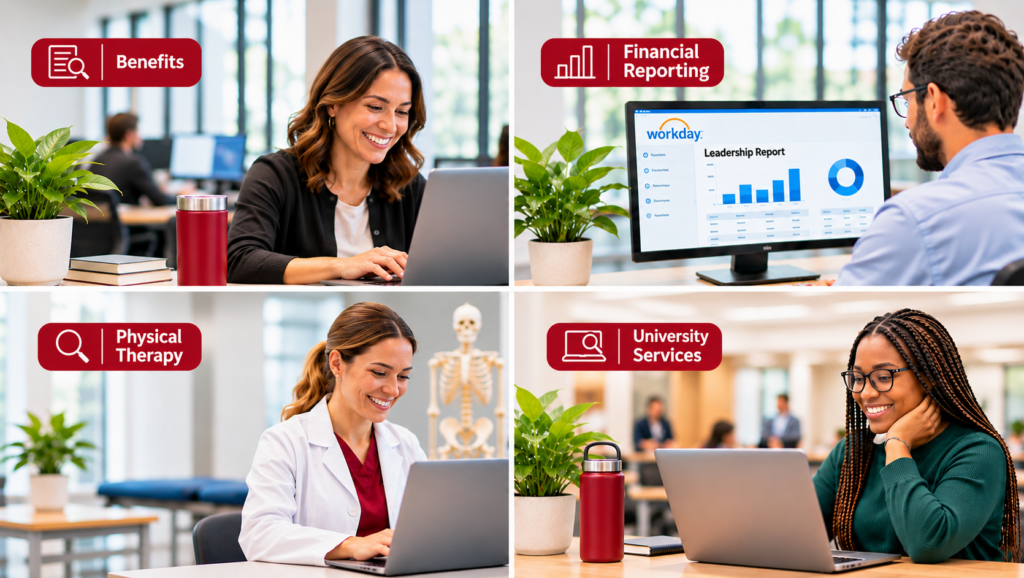
Benefits staff at WashU have thousands of resources and documents to draw from when answering employee questions. The challenge isn’t always whether the answer exists. Sometimes, it’s finding it.
“In the benefits world, we have thousands of resources and documents. It’s sometimes hard to pinpoint where you need to go to find the answer, and you waste so much time. This tool helps us get there faster.”
For Katie Hickman, senior manager, Benefits, and the Benefits Service Center, AI is beginning to change that experience.
Working with Administrative AI, the team developed a proof of concept using Box Hub and Box AI with a curated collection of approved benefits content. The goal was straightforward: help staff find accurate information faster and provide more consistent responses, particularly during high-demand periods such as Open Enrollment.
The pilot established a 30% target for time savings. It also uncovered something the team wasn’t necessarily looking for. When the tool couldn’t answer certain questions, testing pointed to outdated or missing source documentation. Once those materials were updated, the expected answers followed.
The Benefits pilot is one of several efforts underway across WashU exploring a larger question: Where can AI make a meaningful difference in the everyday work of the university?
Two groups within WashU IT, Enterprise AI and Administrative AI, work together to help the university answer that question. Enterprise AI focuses on the technology, platforms and resources that support AI adoption, while Administrative AI works with partners across WashU to identify opportunities, bring together knowledge and expertise, create connections and help turn promising ideas into practical solutions.
Their work is closely connected. New AI capabilities create possibilities for university teams, while the needs, experiences and lessons emerging from those teams help shape how WashU puts AI to work.
Sometimes, the value is time. Senior Financial Data Analyst Emily Totel works with several leadership reports that require information from multiple Workday reports to be assembled manually. In a proof of concept, AI significantly reduced the time required to complete the reporting work, with Totel also reporting time saved and errors avoided.
The project reinforced an important lesson about working with AI: clearly defining the expected outcome before asking the technology to complete a task can make a difference in the result.
Elsewhere, the impact is showing up in how people access information and services.
Catherine Lang, Barbara J Norton professor of physical therapy, reported that her team’s pilot is resulting in fewer emails and in-person questions from students and faculty. At the same time, the work has identified areas where guidelines, policies and other documentation can be improved.
Those experiences point to a broader opportunity. The value of AI isn’t limited to how quickly it completes a task. It can also make information easier to access, improve an experience or reveal opportunities to strengthen the processes and information behind the work.
But putting AI to work effectively also means understanding where technology alone isn’t enough.
University Services is exploring how AI could provide more self-service options for customers, while alleviating some of the in-person and phone demand on the University Services Center. The idea is still being evaluated as questions about implementation are worked through.
For Raven Lumpkins, director of strategic initiatives and communications for University Services, the process has reinforced the importance of human expertise.
“AI is smart, but most certainly requires a human touch to guide it into truly being a supportive tool,” she said.
The work has surfaced legal questions and the need for careful setup before a solution moves forward. Those considerations are as much a part of successful AI adoption as the technology itself.
Together, these examples offer an early picture of what putting AI to work at WashU can look like: less time searching for information, less manual effort, better access to services and new insight into where processes and information can be improved.
For Michelle Fuertes, executive director of IT digital transformation, the opportunity is ultimately about connecting those individual improvements to a broader goal for WashU.
“Our goal is to help people across WashU use AI in ways that create meaningful value,” she said. “Enterprise AI and Administrative AI work together to connect technology with the people, expertise and opportunities across our university, helping translate AI capabilities into better ways of working and more capacity to advance our mission.”
The common thread across these efforts isn’t a particular AI tool. It’s a problem or opportunity worth exploring.
For faculty and staff, that means using AI effectively doesn’t have to begin with knowing which technology to choose. It can begin by looking at the work: Where are people losing time? Where is information difficult to find? Where is a process creating unnecessary friction?
Those questions can help identify where AI can make a meaningful difference and where technology, combined with human knowledge and expertise, can create more capacity for the work that matters most to WashU’s clinical, academic, research and administrative mission.